Exposure, Part 2 - Aperture
Aperture is a less-than- easy a concept for the novice to grasp, but once it’s control and impact is understood, it becomes, perhaps, the most utilized piece of knowledge put to use in your photography arsenal.
Aperture is the hole or opening that light travels through as it’s exposed to the center. The size of the opening is designated by an f-number, also referred to as an f-stop. This is displayed as the function f/x, such as f/5.6 or f/8. The math behind it is a little complex, so I’ll explain it in simplified form: f/x is the focal length of the lens divided by the diameter of the opening. Even in simplified form, it’s not so easy to understand, is it?
In laymen’s terms, all that really needs to be understood about the function itself is that it’s relative to the focal length of the lens. Longer lenses, such as telephoto lenses, will have a larger opening at the same f-number than a shorter lens, such as a wide-angle. An aperture f/5.6 on an 18mm lens will be a smaller hole than f/5.6 on a 200mm lens.
If you recall, when previously discussing shutter speed, a stop denoted a relative factor of light exposure to the sensor. An f-stop has the same relationship with regard to aperture, and the two terms (stop and f-stop) are often used synonymously. Each f-stop denotes a relative increase or decrease in the amount of light, by a factor of 2. If you increase, or widen, the aperture 1 stop, you double the amount of light hitting the sensor. If you decrease, or narrow, the aperture 1 stop, you halve the amount of light hitting the sensor.
This makes the relationship between shutter speed and aperture easy to understand. For a given proper exposure, if you decrease the aperture by 1 stop, you have to compensate by increasing the shutter speed by 1 stop. Likewise, for a given proper exposure, if you increase the aperture by 1 stop, you have to compensate by decreasing the shutter speed by 1 stop. We'll discuss that topic in greater detail in the near future.
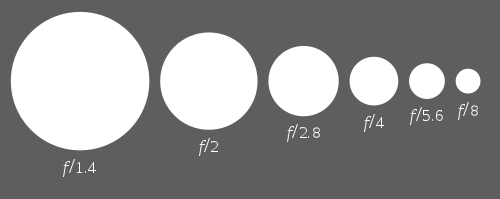
This diagram shows 1 full stop difference between each step. Remember that from each stop to the next is a factor of 2. So, going from f/1.4 to f/2 is half the amount of light, and so on. I’ve found a good way to remember the relative stops is that every other stop is roughly double the previous. So, if you go from f/1.4 to f/2.8, you’ll notice that 2.8 is 1.42. If you go from f/2 to f/4, you’ll notice that 4 is 22. Therefore, you’ll understand when I say that the next full stop after f/8 is f/11 (5.62, roughly), and that the next full stop after f/11 is f/16 (82).
Likewise, a full stop wider than f/1.4 is f/1 (2/2), and a full stop wider than f/1 is f/0.7 (1.4/2). You’ll rarely see lenses with apertures that wide, but some do exist, and it’s helpful to understand the context of the f-stop.
If you’re curious to know what this looks like in effect on an actual lens, here are some examples:
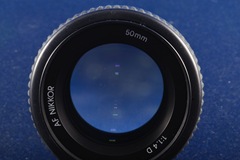
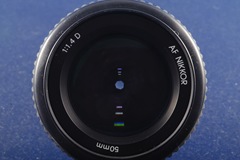
Now that you understand the relationship to exposure that aperture has, it’s important to understand what the artistic impact is. A wide aperture, or a very wide opening, as seen in the top photo above, will result in your main subject being in sharp focus, but the areas in front and behind will be very blurred. The amount of the area in focus will increase as you narrow, or stop down, the aperture. The narrower the opening, the sharper the out of focus areas will be.
Here’s an image taken with a very wide aperture.

With the focal point on the head of the figure in the red mask, and a wide aperture of f/1.4, you’ll notice that very little other than the point of focus is in-focus, including the hands and body of that figure. The area that remains in focus is known as the Depth of Field, or DOF. With a wide aperture like f/1.4, the DOF is very shallow – no more than a few millimeters.
The same scene, taken at a much narrower aperture of f/16 shows the effect of aperture on DOF.

At f/16, the DOF is significantly wider… almost the entire length of my shooting platform, which is 12”.
Opening or closing your aperture is how you control DOF, and using DOF effectively allows your photos to have a real impact on the viewer. Using a wide aperture gives you a narrow DOF, which can allow you to isolate your subject from the background.

Likewise, narrowing your aperture can allow you to get your entire scene in sharp focus, from very near to far away (infinity focus).

As with shutter speed, there is no “right” or “wrong” when it comes to DOF. It’s all about the artistic vision you’re trying to convey in your image. Now that you understand the components of aperture and shutter speed, you’ll be able to make better artistic decisions in determining how your images will appear. Next we’ll discuss ISO, and tie all of the elements of exposure together.